

Physics
Everything the Standard Model predicts has been found. And yet almost everything in the universe remains unexplained by it.
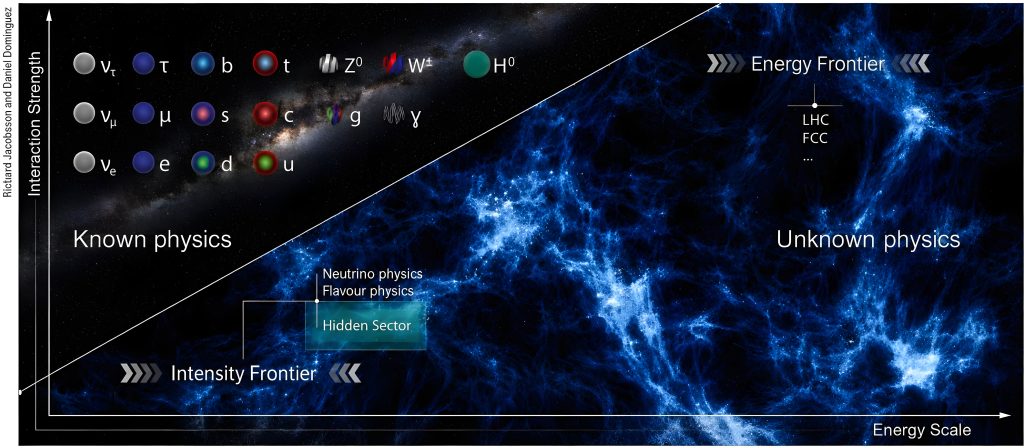
SHiP is built on a particular suspicion: that the particles we are missing are not hiding beyond our reach in energy, but standing quietly in front of us, interacting too feebly to have ever announced themselves.
What the Standard Model cannot account for
Four things, and they are not small. Neutrinos have mass, which the theory in its original form forbids. The universe is made of matter rather than equal parts matter and antimatter, and nothing in the Standard Model produces an imbalance anywhere near large enough. Most of the matter in the cosmos is dark, and no Standard Model particle fits. And the early universe appears to have undergone a period of rapid expansion driven by a field the theory does not contain.
Each of these is evidence of something absent. None of them tells us how heavy the missing thing is.
Two ways for a particle to stay hidden
A new particle can escape detection because it is too heavy to create. That is the case the LHC was built to test, and it has pushed the limits on heavy new physics remarkably high.
But a particle can also escape detection because it interacts too weakly to leave a trace — produced in your beam, passing through your detector, gone. Raising the collision energy does not help. What helps is producing an extraordinary number of collisions and building an instrument patient enough to notice a single decay.
This second region — light masses, minuscule couplings — is very largely unexplored. It is where SHiP looks.
The portals
If the hidden particles carry no ordinary charge — no electric charge, no colour, no weak charge — then they cannot couple to us through any known force. But they can still couple through a small number of specific combinations that the symmetries of the Standard Model happen to permit.
Remarkably, there are only three such combinations of the simplest kind. Three doors between our sector and whatever lies on the other side. A fourth, of a slightly different character, is opened by axion-like particles. Each door predicts its own signatures, and SHiP is designed to watch all of them at once.
The vector portal
A second kind of light
Suppose there is another force like electromagnetism, with its own carrier — a dark photon. It would not couple to ordinary charge directly, but quantum mechanics allows it to blend slightly with the ordinary photon, borrowing a trace of its behaviour. That faint blending is the whole interaction.
Such a particle is a natural mediator between us and dark matter, and it has been invoked to explain the long-standing discrepancy in the magnetic moment of the muon, and the way dark matter appears to interact with itself in galaxy clusters.
The scalar portal
A shadow of the Higgs
The Higgs field is the only place in the Standard Model where a new neutral particle can attach without disturbing anything. A hidden scalar can mix with it, acquiring a very small share of the Higgs’s interactions and inheriting its preference for coupling most strongly to heavy particles.
Scalars of this kind appear in theories of inflation, in supersymmetric models with an extra singlet, and in whole hidden sectors whose only visible consequence would be a rare, long-lived decay.
The neutrino portal
The heavy siblings
The most economical of the four, and arguably the most consequential. Add heavy neutral leptons — the missing right-handed counterparts of the neutrinos we know — and several unrelated problems resolve at once.
Their existence would explain why the ordinary neutrinos have such tiny masses. Their decays in the early universe could have generated the imbalance between matter and antimatter. And the lightest of them, if sufficiently long-lived, could itself be the dark matter. Three of the Standard Model’s four failures, addressed by one addition.
Axion-like particles
Relics of a broken symmetry
When a symmetry of nature breaks, it can leave behind a very light particle as a kind of scar. The axion was the original example, invented to explain why the strong force respects a symmetry it need not. Many theories predict similar particles more generally.
They couple through a different mathematical structure than the other three portals, typically to pairs of photons or gluons, or to fermions. Their lightness is not a coincidence to be explained away but a direct consequence of how they came to exist.
Beyond the four doors
Supersymmetry is usually discussed as physics for the highest energies, but some of its versions predict light, long-lived particles instead: a very light neutralino that decays slowly because the symmetry protecting it is only slightly broken, or light states left over from whatever breaks supersymmetry in the first place. These would be invisible to searches designed for heavy sparticles, and visible to SHiP.
The same beam also allows a search for dark matter light enough to be produced directly and detected by its scattering — a regime that direct-detection experiments underground struggle to reach.
The neutrino we barely know
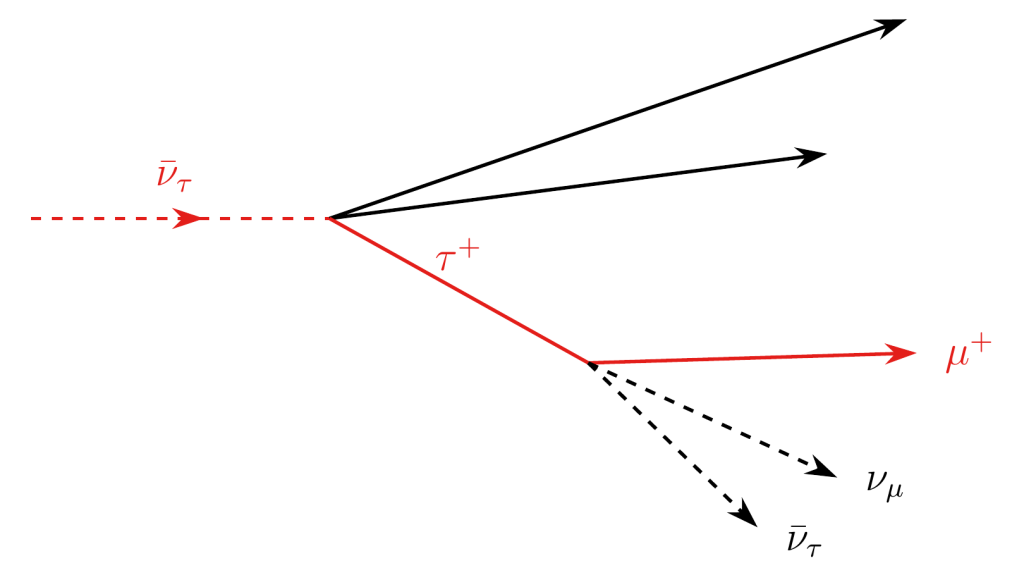
Of the three neutrinos, the tau neutrino has been observed a mere handful of times, and for years its antiparticle had never been directly seen at all. It is the least measured particle in the Standard Model.
SHiP’s beam will produce them in enormous numbers, and a dedicated detector sits close to the target to record their interactions. Beyond simply counting them, this opens measurements of how neutrinos of each flavour scatter off nucleons, constraints on the tau neutrino’s magnetic moment, and a probe of the internal structure of the proton in a region other experiments cannot reach.
A decay that should never happen
The Standard Model permits a tau lepton to decay into three muons only through an extraordinarily suppressed route — a rate so small that no conceivable experiment could see it.
This makes it a clean test. There is no background of ordinary physics to subtract and no ambiguity to argue over. If the decay is observed at all, at any rate within reach, the Standard Model is incomplete in a specific and measurable way.
What is at stake
Neutrino mass. The dominance of matter over antimatter. The identity of dark matter. The origin of inflation. These are not separate curiosities; several of them may have a single answer, and that answer may be light enough and feeble enough to have been sitting just past the edge of every experiment so far.
SHiP is an attempt to look there.