

The SHiP Facility
SHiP will be housed in the Beam Dump Facility (BDF), a new installation in ECN3, an existing underground experimental hall in CERN’s North Area. The facility is designed to take the most intense proton beam the SPS can deliver, stop it in a dense target, and then remove almost everything the collision produces except for the long-lived particles SHiP is looking for.
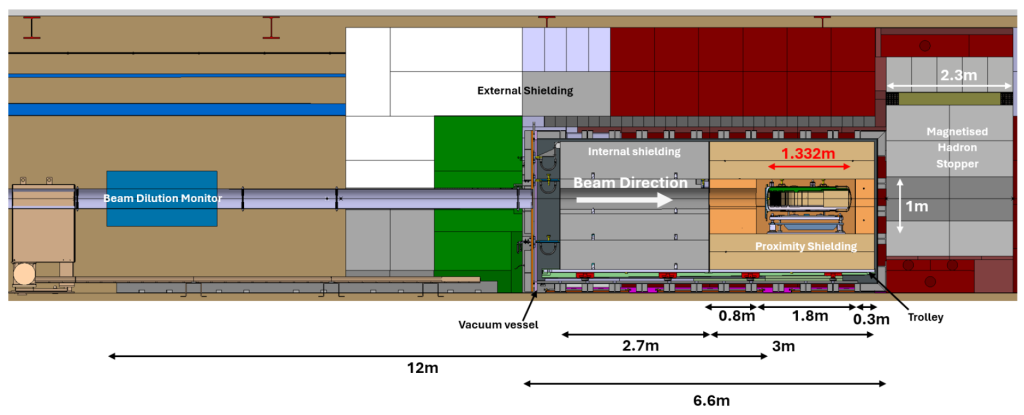
Layout of the Beam Dump Facility in ECN3, looking along the beam line.
A new facility in an existing hall
SHiP is being built at the ECN3 hall in the North Area at CERN. Reusing an existing hall means the civil engineering is limited to modifications rather than new excavation, but it also constrains the length available for the target complex, the muon shield and the decay volume, which had to be redesigned to fit.
The proton beam
The SPS delivers protons at 400 GeV/c. Rather than arriving in short bunches, the beam is slow-extracted over roughly one second, spreading the energy deposition in time so the target can survive it. The facility is designed for about 4×10¹⁹ protons on target per year, and around 6×10²⁰ over the lifetime of the experiment. This sharing of the SPS beam is what allows SHiP to run alongside the rest of CERN’s fixed-target and LHC programme.
Target and hadron absorber
The target is built from a stack of water-cooled blocks of a molybdenum alloy in the upstream section and pure tungsten downstream, chosen to be as short as possible in interaction lengths so that the charm and beauty hadrons produced decay before they can be reabsorbed. Immediately behind it sits a massive iron hadron absorber, which stops the hadronic and electromagnetic component of the shower. What emerges from the absorber is essentially only muons and neutrinos.
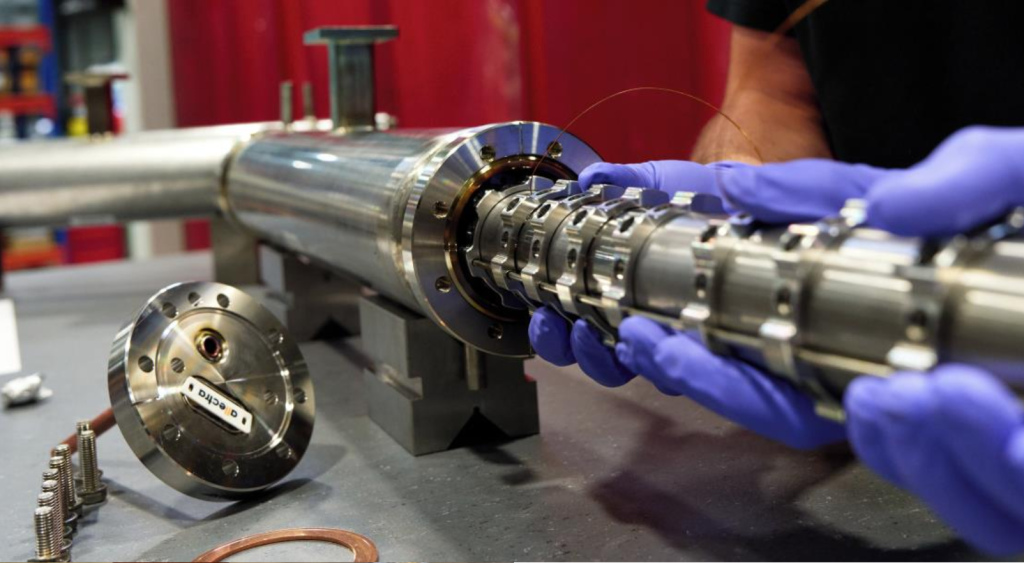
The target assembly and hadron absorber during prototyping.
The muon shield
Muons are the dominant background for SHiP, and there are far too many of them to absorb passively in the space available. Instead the facility uses an active shield: a sequence of magnets that sweeps muons of both charges progressively further away from the beam axis, so that by the time the beam reaches the decay volume the muon flux through the detector is reduced by many orders of magnitude. The geometry of this shield has been optimised extensively, and it is one of the defining features of the facility.
The decay volume
Downstream of the shield is a long evacuated decay volume, tapering outwards along the beam direction to match the angular acceptance of the detector. Keeping it empty suppresses the neutrino interactions that would otherwise mimic a hidden particle decay. Its walls are instrumented as a background tagger, so that any particle entering from outside is recorded and the event rejected.
Construction and schedule
BDF and SHiP were approved in 2024. Work is now focused on the engineering design of the target complex and the modifications to ECN3, alongside prototyping and test beam campaigns for the detector subsystems. The experiment is expected to begin taking data in 2033.