

The SHiP Detector
The SHiP detector is built around a simple requirement: to see a handful of decays while rejecting essentially every other particle that reaches it over 15 years of operation. That drives an unusual design — a large, empty, evacuated volume where a hidden particle can decay, surrounded and followed by instrumentation whose main job is to prove that nothing entered from outside.
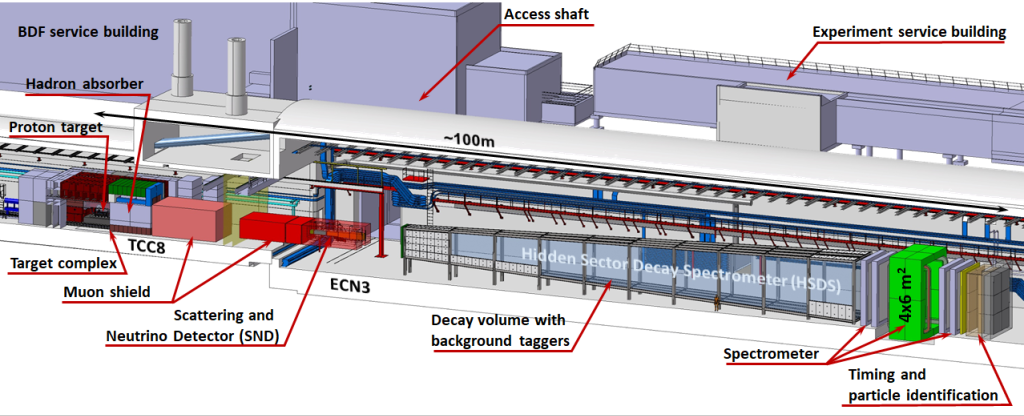
Layout of the SHiP detector, with the beam entering from the left.
Two experiments in one beam line
The apparatus has two distinct parts. Immediately downstream of the target, inside the muon shield, sits the Scattering and Neutrino Detector, which studies particles that interact. Further downstream, after the decay volume, sits the Hidden Sector Decay Spectrometer, which reconstructs particles that decay. They see the same protons on target and run simultaneously.
Scattering and Neutrino Detector
The SND combines a dense target of tungsten plates interleaved with precise silicon tracking detectors and high granularity detectors sitting inside a magnetic field. The emulsion provides micrometre-scale resolution, enough to resolve the short kink of a tau lepton decays produced by tau neutrino interactions, The SND is the part of SHiP that will record tau and anti-tau neutrino interactions in numbers no previous experiment has approached.
Decay volume and background taggers
The decay volume is kept empty so that neutrinos passing through it have almost nothing to interact with. Its walls are lined with the Surrounding Background Tagger, liquid scintillator cells that flag any charged particle crossing into the volume from outside. An Upstream Background Tagger performs the same role at the entrance. Together they let the experiment veto the combinatorial background that would otherwise swamp a search for rare decays.
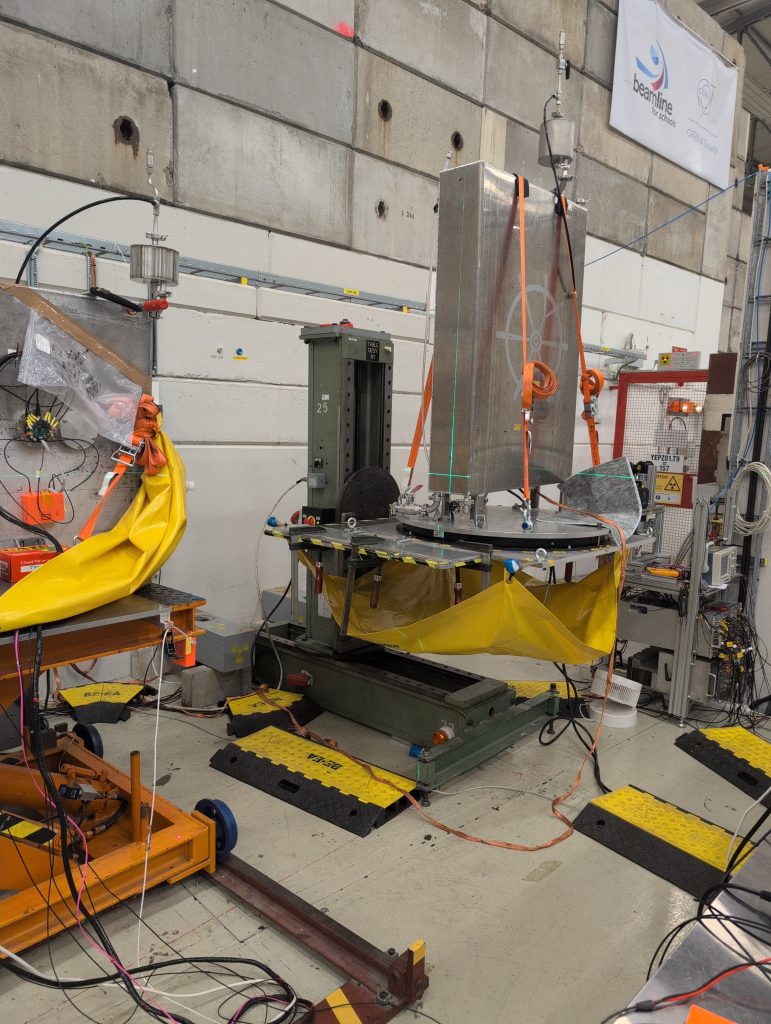
A Surrounding Background Tagger cell under test.
The spectrometer
Charged decay products are tracked by four stations of straw tubes arranged around a large dipole magnet. The straw tracker measures the momentum and charge of each track and reconstructs the decay vertex inside the volume, while the very low material budget keeps multiple scattering small enough to resolve the invariant mass of the parent particle.
Timing, calorimetry and muon identification
A timing detector between the tracker and the calorimeter measures track arrival times to less than fifty picoseconds, which suppresses fake vertices built from unrelated tracks. The electromagnetic calorimeter is designed not only to measure photon energies but also to reconstruct their direction, so that decays into two photons can be pointed back to a vertex in an otherwise empty volume. Behind it, the hadronic calorimeter measures the energy of nuclear particles and allows the identification of any surviving muon.
Prototyping and test beams
Every subsystem above is being prototyped and exposed to test beams at CERN, with the results feeding back into the engineering design. This programme runs continuously between now and installation, and is where much of the collaboration’s day-to-day work happens.