

Discover SHiP
Almost everything we know about matter is described by one theory, the Standard Model. It is extraordinarily successful and also plainly incomplete. SHiP is an experiment built on a specific idea about why: that the particles we are missing may not be too heavy to make, but too shy to notice.
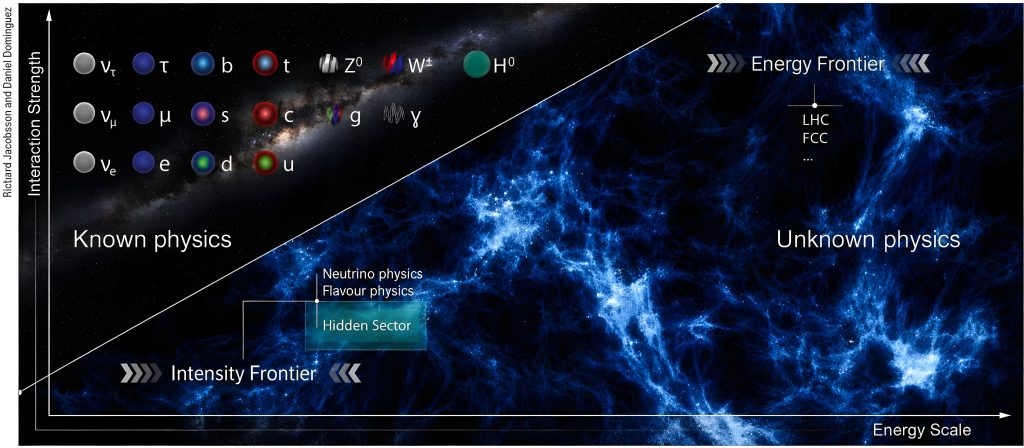
The state of our understanding of elementary particle physics. What we know is produced at low energies and interacts strongly. What we don’t know either needs a lot of energy to have been produced or is too faint to have been produced or seen.
What the Standard Model leaves out
There are notably three things the Standard Model doesn’t account for: most of the matter in the universe is dark, it doesn’t interact with ordinary matter, and nothing in the Standard Model fits the description. The universe is made of matter rather than equal parts matter and antimatter, and the theory does not explain the imbalance. And neutrinos have mass, which the Standard Model forbids. Each of these points to physics we have not yet found.
Two ways to miss a particle
You can fail to discover a particle because it is too heavy to produce: you simply do not have enough energy to obtain it through E = mc². That is the problem that large colliders tackle by colliding protons at the highest energies achievable. But you can also miss a particle because it interacts too feebly — it is produced, passes through your detector, and leaves no trace, or perhaps isn’t produced at all. No amount of extra energy helps with that. A vastly more particles need to be produced to have a chance to see those particles, this requires building an apparatus precise enough to catch a rare event.
This is the intensity frontier, and it is where SHiP works. The experiment sets out to explore beyond the edges of human understanding for the rarest events imaginable.
How a beam dump experiment works
Instead of colliding two beams, SHiP fires a single extremely intense proton beam into a block of dense metal and stops it dead. The number of collisions is enormous. Almost everything produced — the pions, the kaons, the fragments of nuclei — is absorbed within a few metres of metal. Muons, electrons’ heavier cousins, travel further and are pushed aside by a long array of magnets.
The only thing that can pass through all of that untouched is precisely what SHiP is hunting. A particle that barely interacts with matter sails through the shielding, travels tens of metres, and then, somewhere in a long empty vessel, decays into ordinary particles that a detector can see.

From target to decay volume: the beam is stopped, the background is removed, and what remains is carefully watched.
Looking for something in an empty room
The signature is a pair of tracks appearing out of nothing in the middle of a nothing. Nothing should be there, so the experiment’s real difficulty is not detecting the decay but proving that nothing crept in from outside to fake it. The walls of the decay volume are instrumented for exactly this reason, and the goal is a search in which the expected background is essentially zero. In that regime even a single well-reconstructed event is meaningful.
Neutrinos along the way
The same beam that might produce hidden particles certainly produces neutrinos, in vast numbers and of all three types. The tau neutrino is the least studied particle in the Standard Model, observed so far only a handful of times and the tau antineutrino was never observed. A dedicated detector sits close to the target to record them, and SHiP expects tens of thousands of tau neutrinos and antineutrino interactions every year.
Where the project stands
SHiP and the Beam Dump Facility that will host it were approved by CERN in 2024, after more than a decade of design work. The collaboration is now building and testing prototypes of every detector subsystem while the facility itself is being built. Data taking is expected to begin in 2033.
Event Display
You may also experience SHiP through our event display!